Due Diligence Questionnaire (DDQ): A Practical Guide for Fund Managers
A due diligence questionnaire (DDQ) is the set of written questions an institutional investor or investment consultant sends a fund manager before committing capital to one of its funds. It covers the firm, the team, the strategy, risk, operations and compliance, and the answers go a long way toward deciding whether the manager moves on to meetings, an onsite visit and, eventually, an allocation.
The work behind a DDQ is repetitive in a way that is easy to underestimate. The same questions on valuation, key persons, cybersecurity and service providers arrive from one LP after another, each in its own wording and format. The information needed to answer them is spread across departments, in compliance manuals, offering documents, risk reports and last year's responses, and IR teams end up reconstructing answers the firm has already given and approved, usually against a tight deadline.
This guide is written for the folks who fill DDQs in: investor relations, IR operations and fund operations teams at private equity, private credit and hedge fund managers, long-only managers answering consultant questionnaires, and emerging managers facing their first one. It explains what a DDQ is, walks through the ILPA and AIMA templates in plain language, breaks a typical questionnaire down section by section with example answers, and sets out a step-by-step response process. There is also a free DDQ response tracker.
What is a due diligence questionnaire (DDQ)?
A due diligence questionnaire is a fund manager's written account of how its firm and fund operate, set out question by question in a format the investor controls. Investors treat it as the factual baseline for diligence: they check the answers against the documents behind them, test them in meetings and onsite visits, and keep them on file to compare with the next year's response.
A DDQ usually arrives as a Word or Excel file or through an investor's online portal, and it can be anything from a short update form to a full questionnaire with a list of supporting documents requested alongside it. Some investors start from an industry template such as the ILPA or AIMA DDQ, covered below, while others write their own. Procurement and IT security teams also use the term for the questionnaires they send to suppliers, which is a separate exercise this guide does not cover.
Managers usually receive a DDQ at one of three points:
- A new allocation: A prospective investor is considering a first commitment to a fund or strategy.
- The annual update or re-up: Existing investors refresh their files each year, and again before committing to the manager's next fund.
- A consultant database refresh: Investment consultants ask managers to update the profiles they use to screen and recommend managers to their clients.
DDQ vs RFP vs RFI
Investors often send all three documents over the course of a single manager search, and the questions overlap enough that teams reuse answers across them.
Investment vs operational due diligence (ODD)
Investment due diligence asks whether the strategy can deliver what the manager says it will. It looks at the team, the source of its edge, how ideas move through the investment process to decisions and position sizing, and whether the track record supports the story the manager tells about it.
Operational due diligence (ODD) asks whether the firm can run investors' money safely. It covers who administers the fund, how assets are valued and by whom, how cash moves and who can authorise it, which service providers the firm relies on, and how compliance, cybersecurity and business continuity are managed. A strong investment case still fails if the ODD review does, and large allocators often run ODD through a separate team with its own questionnaire and its own veto. That is why managers frequently answer two DDQs for one investor.
Who sends DDQs, and what they're checking
Every institutional investor runs some version of an LP due diligence questionnaire, and each type of sender tends to lean on different parts of it.
- Pension funds focus on governance, fees, alignment of interest and operational controls, and review answers against their fiduciary duties to beneficiaries.
- Endowments and foundations look closely at long-term alignment, team stability and, frequently, responsible investment policies.
- Sovereign wealth funds concentrate on scale, governance and controls, often through detailed operational reviews.
- Funds of funds compare strategy, track record and terms across many managers in the same asset class.
- Family offices weigh alignment, transparency and the people behind the fund, with formats that range from a full template to a short list of questions.
- Investment consultants standardise answers into their manager databases and research ratings, which they use to recommend managers to clients.
Large allocators often split the work, with an investment team sending one questionnaire and a separate ODD team sending another. The practical consequence for the manager is that every investor sends its own version of the same questions, so the firm describes its valuation policy, its key-person provisions and its cyber controls many times a year in slightly different words. That repetition is the reason an answer library pays off.
The industry-standard DDQ templates
Two industry bodies publish the templates that a large share of institutional DDQs start from, and knowing their structure saves a lot of rework.
The ILPA DDQ (private equity and private markets)
The Institutional Limited Partners Association (ILPA) represents institutional investors in private funds. Its due diligence questionnaire was created to reduce the number of custom questionnaires general partners receive, by giving LPs a common set of questions to begin from. ILPA first introduced the DDQ in 2013 and updated it in 2016 and 2018. The current version, ILPA DDQ 2.0, was published in November 2021 and remains the latest edition. It uses private equity as its reference point and groups its questions into 20 topics: firm and fund information, succession planning and key persons, investment strategy, co-investments, GP-led secondaries and continuation funds, credit facilities, investment process, team, alignment of interests, market environment, fund terms, governance, risk and compliance, track record, accounting and valuation, reporting, legal, data security and third parties, ESG, and diversity, equity and inclusion. Appendices list the documents an LP would expect to receive and provide templates for team, fund and portfolio data. ILPA has said it is developing further modules for real estate, private credit, infrastructure and small and emerging managers.
LPs favour a standard ILPA due diligence questionnaire because it makes managers comparable, and GPs benefit because a well-maintained ILPA DDQ response covers a large part of what custom questionnaires ask. ILPA publishes the template and its user guide on its due diligence questionnaire page. For DDQ private equity work at the platform level, see our page on AI for private equity firms.
The AIMA DDQ (hedge funds and alternative managers)
The Alternative Investment Management Association (AIMA) is the global trade body for alternative investment managers, and it published its first DDQ for investors in hedge fund managers in 1997. The current AIMA DDQ, the Illustrative Questionnaire for the Due Diligence of Investment Managers, has been modular since 2017: a template is assembled from the modules that fit the manager's structure and strategy. AIMA released the 2025 edition in March 2025 and published a final 2025 edition later that year after member feedback. The 2025 edition adds a private markets strategy module and a decision tree that recommends the right template after a few short questions, with templates for trading strategies, corporate lending, private markets, funds of funds, systematic strategies, digital assets and platform managers. The corporate lending and private markets templates are also published under the Alternative Credit Council (ACC) brand. The questionnaire is available to AIMA members, and the 2019 modules remain usable while firms move across. AIMA hosts the templates on its due diligence questionnaires page. For how this hedge fund due diligence questionnaire work fits a wider platform, see AI for hedge funds.
Consultant and long-only questionnaires
Long-only managers see fewer ILPA and AIMA templates and more of the formats investment consultants use. Each consultant runs its own questionnaire and its own database, and the content overlaps heavily with the RFPs and RFIs written for the same strategy. A sensible approach for asset and wealth managers is to treat consultant questionnaires, RFPs and DDQs as one body of answers, maintained once and adapted to each format.
ESG and DEI sections
ESG and DEI questions now sit inside the standard templates. ILPA DDQ 2.0 has dedicated ESG and DEI topics, the ESG section draws on the PRI's Limited Partners' Private Equity Responsible Investment DDQ, and ILPA publishes a Diversity Metrics Template alongside the questionnaire. ILPA added a DEI Monitoring Questionnaire in 2023 for investors who want more regular check-ins, and in 2025 the PRI released a supplementary climate module for its DDQ in collaboration with ILPA and the iCI. On the hedge fund side, AIMA publishes a separate Responsible Investment DDQ, updated in March 2025, and its decision tree asks whether responsible investment questions belong in a manager's template. Investors vary widely in how much weight they put on these sections, which makes it worth keeping one approved policy description and adjusting the depth for each investor.
What's in a DDQ: section by section
Whatever template an investor uses, the questions fall into roughly the same sections, and each one expects evidence behind the answer. The table below sets out what allocators look for in each section, and which internal documents hold the answer.
Due diligence questionnaire example: sections and sources
Three sections tend to slow teams down. Track record questions ask for attribution and dispersion in formats that rarely match internal reports, ODD sections pull in service providers and controls owned outside the IR team, and ESG answers depend on policies that a different group maintains and updates on its own schedule.
DDQ example: illustrative questions and answers
The answers below are illustrative. They are written for a fictional manager to show the level of detail allocators expect, and every detail has to be replaced with your firm's approved wording. Bracketed items mark facts each firm fills in for itself.
Each example names who is responsible, states how often the control runs and points to the document behind it, which is what an allocator checks first.
Why DDQ preparation takes so long
The questionnaires differ from one investor to the next, while the work behind them repeats, and six things make a DDQ response heavier than its page count suggests.
- Multiple teams contribute to one response: Portfolio management, compliance, legal, operations, risk and IT each own part of the answer, and IR has to coordinate all of them against a single deadline.
- The same questions arrive from every LP: Each investor phrases and orders its questions its own way, so a team answers the same underlying question many times a year without an easy way to see that it already has.
- Answers have to stay consistent: One investor holds last year's response, a consultant holds another and the factsheet says something too, so every new answer has to agree with what the firm has already said or explain why it changed.
- Version control breaks down: Approved wording ends up spread across old DDQs, email threads and shared drives, and it becomes hard to tell which version compliance actually signed off.
- Evidence has to be collected: Investors ask for the policy, report or agreement behind an answer, and tracking down the current version of each document can take as long as writing the answer.
- Everything comes back every year: Annual updates and re-ups repeat the whole cycle, with figures, team members and service providers changed in between.
Each of these is a problem of finding, checking and keeping track of approved information, which is the part of DDQ work that a well-run process, and software such as Pascal AI, can take off the team's desk. The steps below show where.
How to answer a DDQ, step by step
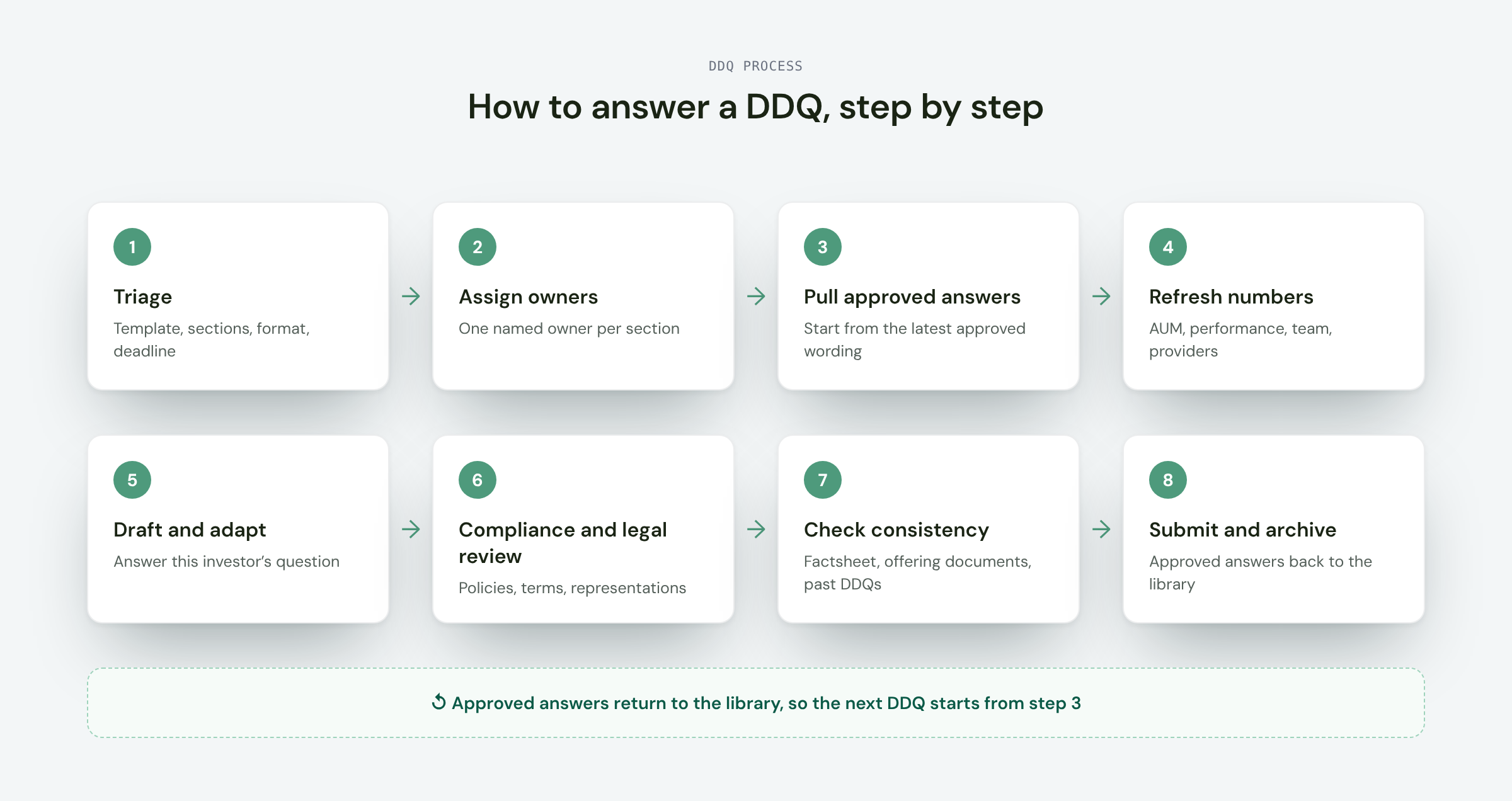
A repeatable DDQ process looks broadly the same whether the questionnaire is a short consultant update or a full ILPA response. These eight steps take a DDQ response from intake to submission.
1. Triage the scope and deadline: Before anyone writes an answer, establish which template the investor is using, how many sections it has, what submission format it expects (portal, Word, Excel or PDF) and when it is due. Note anything unusual, such as investor-specific questions or requests for supporting documents, and set an internal deadline that leaves time for review.
2. Assign an owner to each section: Give every section one named owner: portfolio management for strategy and process, compliance for regulatory and policy questions, legal for terms and litigation, operations for service providers and controls. IR or client service coordinates the whole response and owns the final deadline.
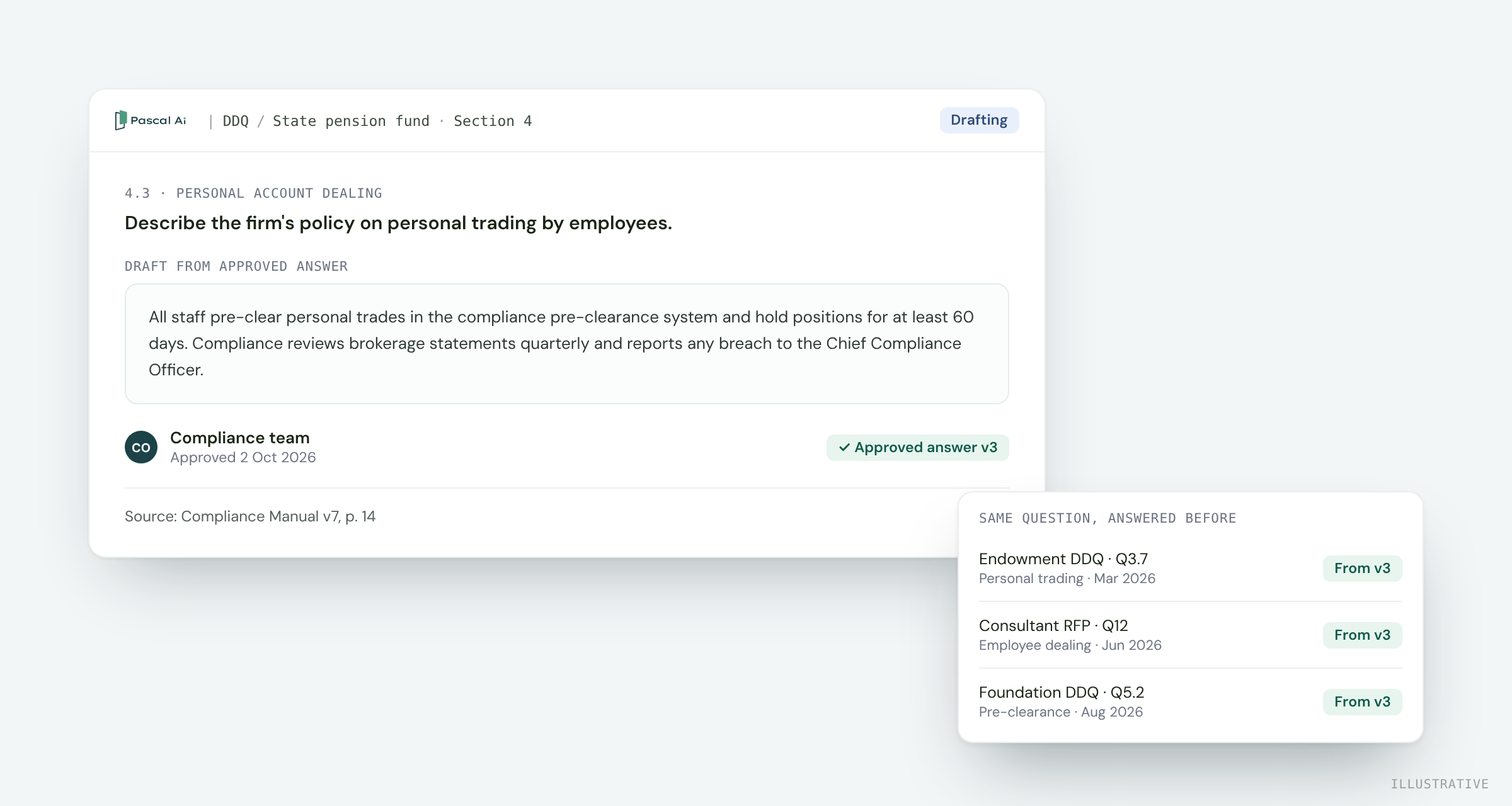
3. Pull approved answers from your library: Start every answer from the most recent approved wording, and note the date it was approved and the document it rests on, because reviewers will need both.
How Pascal AI handles this step: When a DDQ arrives in the investor relations inbox, Pascal AI gathers past DDQs, policies and fund documents and drafts each answer from approved language in the context graph. Every approved answer carries who approved it and when, so the team can see what each draft starts from, and a question worded differently from last year's can still start from the answer compliance already signed off.
4. Refresh every number from source: AUM, performance, headcount, service providers and key dates go stale between DDQs, and a stale figure is one of the easier errors for an investor to spot, since it can be checked against the factsheet. Pull each figure from its system of record and use one as-of date across the whole response.
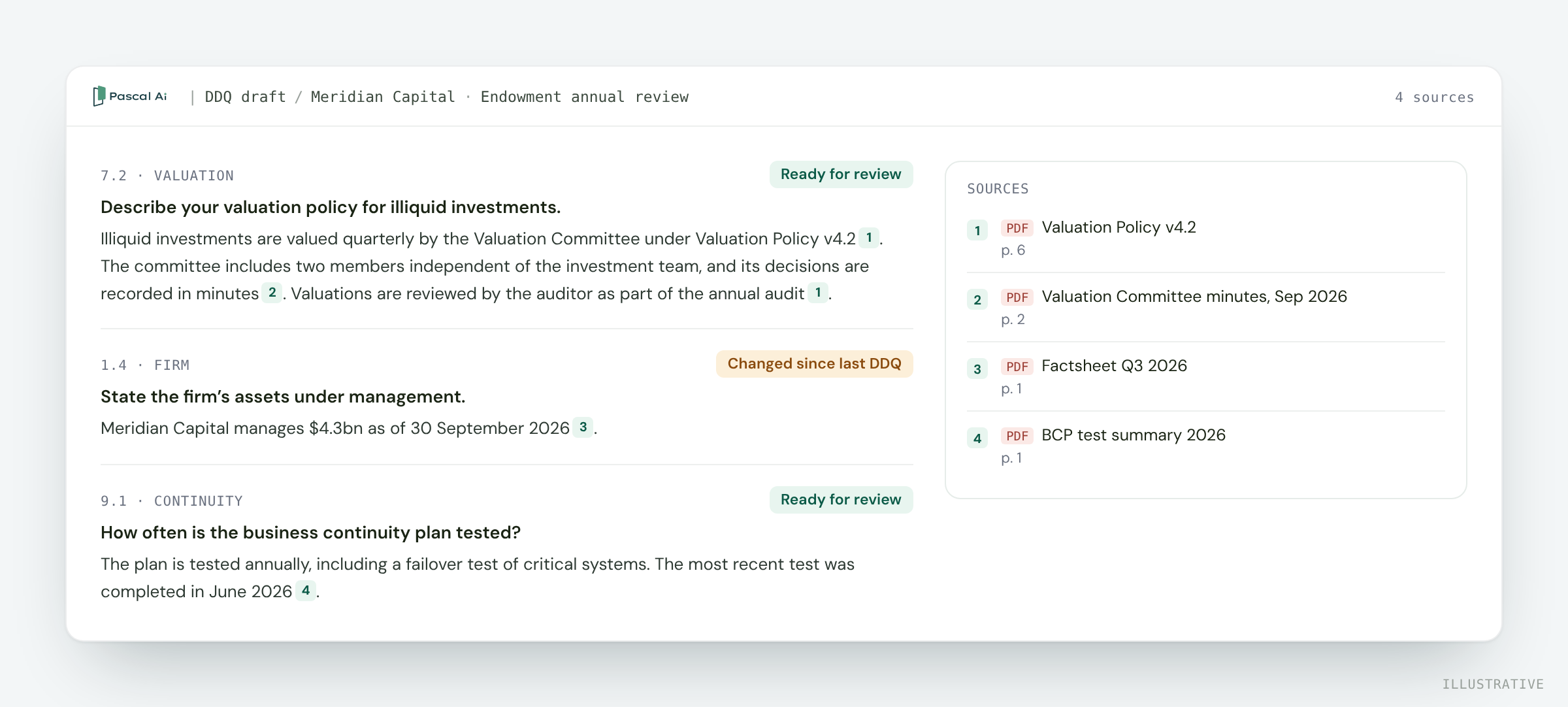
How Pascal AI handles this step: Every claim in a Pascal AI draft, figures included, is cited to the source document and page it came from, so a reviewer can open the document behind each number and confirm it is current before the response goes out.
5. Draft and adapt answers to this investor: Read each question closely, answer what it asks at the length it implies, and adjust emphasis where you know the investor's priorities, for instance a pension fund's attention to fees or an endowment's interest in responsible investment. Record any investor-specific tailoring so it can be reviewed and, where useful, added to the library.
6. Compliance and legal review: Compliance checks that answers match current policies, registrations and marketing rules. Legal reviews anything touching fund terms, side letters, litigation or statements the firm could be held to, and the review moves faster when each answer arrives with its source document attached.
7. Check consistency across documents: Read the finished response against the latest factsheet, the offering documents and the DDQs already sent to other investors. Consultants keep past responses on file, and an answer that differs from last year's without explanation will usually prompt a follow-up question.
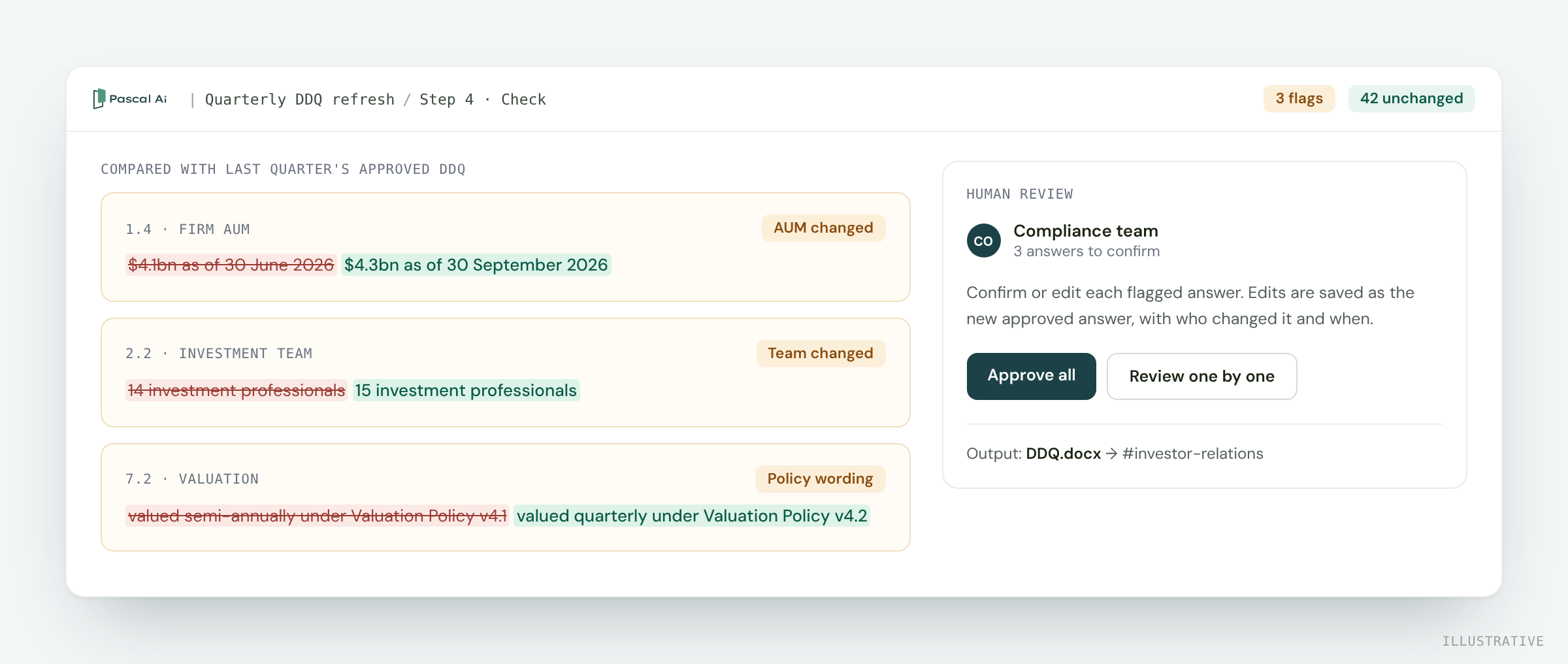
How Pascal AI handles this step: Pascal AI compares every answer with the last approved DDQ and flags any change to AUM, team, strategy or policy wording, so the compliance reviewer sees exactly what has moved since the firm last answered and can confirm or correct it.
8. Submit, then archive: Submit in the format the investor requested and keep a copy of exactly what was sent. Then write the approved answers back into your library with their approval date, approver and source, so the next DDQ starts from this one.
See Pascal AI draft your next DDQ from approved answers →
Free download: DDQ response tracker
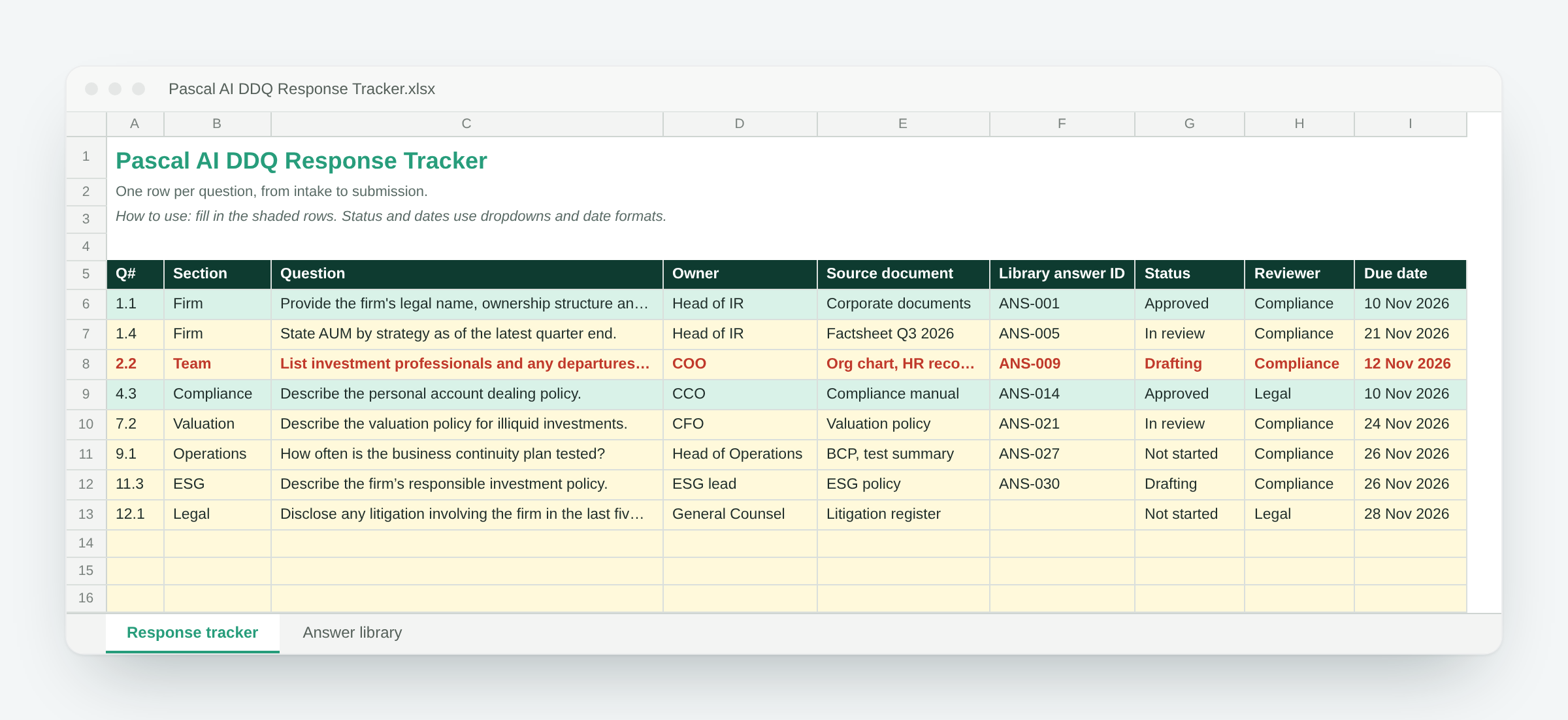
The Pascal AI DDQ Response Tracker is a free due diligence questionnaire template for managing one DDQ from intake to submission. It has two tabs: a response tracker with one row per question covering owner, source document, status, reviewer and due date, and an answer library for approved answers with their data points, approver and next review date. Fill in the short form on our demo page and we'll email the tracker to you, ready to use as a DDQ template in Excel or Google Sheets, with or without Pascal AI.
Get the free DDQ response tracker →
Building a DDQ answer library
Pascal AI's context graph is a working example of what an answer library can look like: every approved answer sits in one place, linked to the document behind it and the person who approved it. When compliance edits an answer, the edited version becomes the approved answer, with who changed it and when, and the next DDQ starts from it. Read more about keeping approved answers in one place.
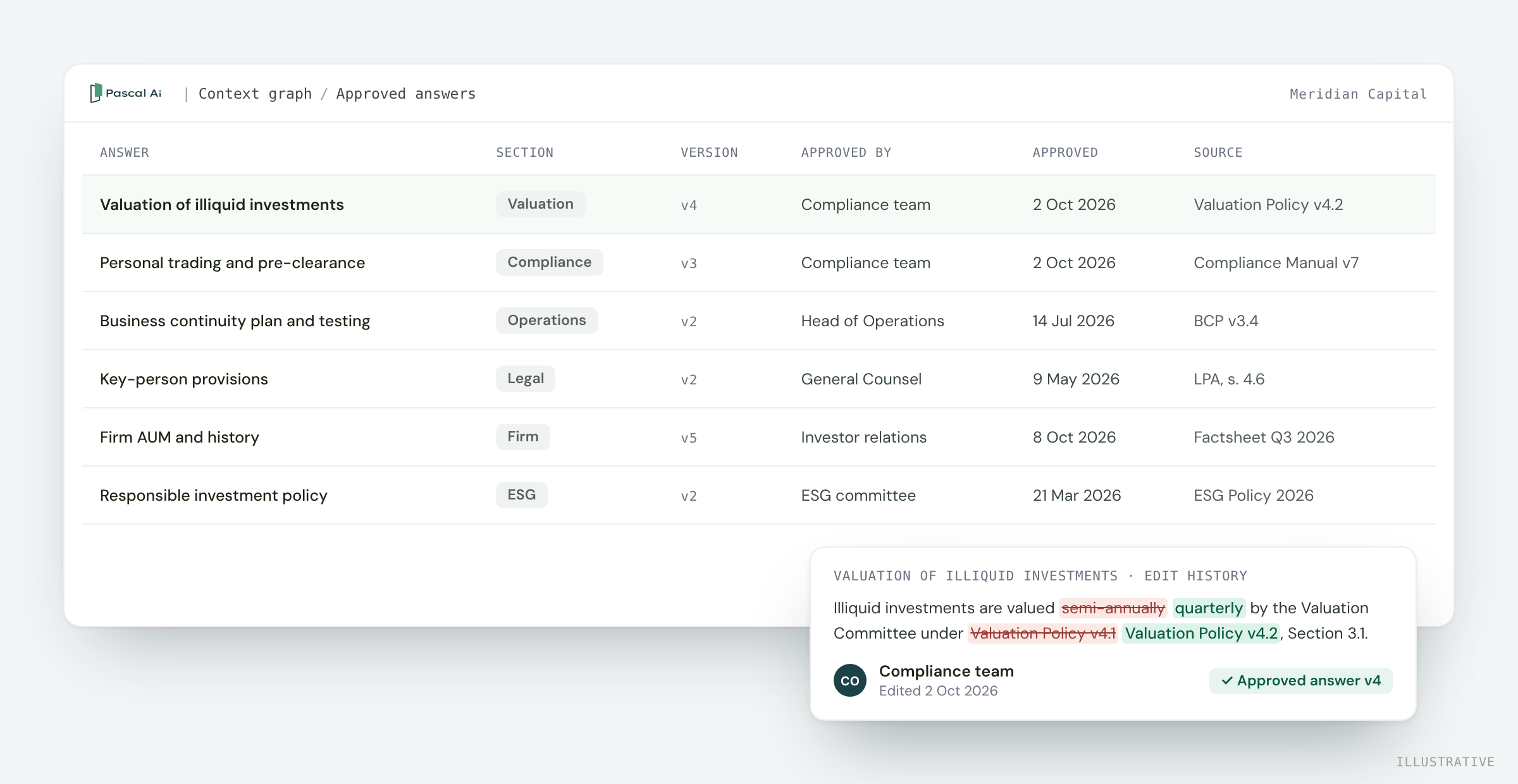
The same principles work in a spreadsheet or a shared drive, and the Answer library tab in the tracker above is built around them.
- Organise by DDQ section, so answers map onto the templates investors use.
- Give each section one owner who keeps its answers current.
- Store the evidence document beside each answer, whether a policy, a report or an agreement.
- Mark the data points that go stale, such as AUM, headcount and performance, so they are refreshed and never copied.
- Set a review date for every answer and check it before reuse.
- Keep one approved version of each answer and retire the old ones.
Common DDQ mistakes
- Figures that don't match the factsheet: Pull every number from the same source and as-of date as the latest factsheet.
- Stale answers copied forward: Give each library answer a review date and refresh it before it goes into a new response.
- Generic boilerplate that ignores the question: Answer what the investor asked, in the order they asked it, before adding standard language.
- Missing evidence documents: Attach or reference the policy, report or agreement behind each claim, since investors often ask for it.
- Answers far longer than the question needs: Match length to the question, so a yes-or-no question gets a direct answer and a sentence of context.
- Missed deadlines because no one owned a section: Name an owner for every section on day one and track status against an internal deadline.
How AI is changing DDQ work, and how Pascal AI answers one
AI is useful in DDQ work wherever the job is finding, matching and checking text. It can locate the approved answer to a question phrased in a new way, produce a first draft from that approved text and compare a response against earlier DDQs to catch changes and contradictions. Judgement on how to answer a sensitive question stays with people, as does approval of every answer and the compliance sign-off that turns a draft into the firm's statement. The risks to manage are concrete: confidential material has to stay under the firm's control, a model that invents a figure or a policy detail creates a misstatement the firm is responsible for, and drafts that drift from approved wording undo the purpose of having an approved version. One should give any AI tool used on DDQs access only to what it needs, check its sources, and keep a named person accountable for what goes out.
How Pascal AI answers a DDQ
The way we do it is to run a DDQ as a workflow over the firm's own approved documents. When a DDQ arrives in the investor relations inbox, Pascal AI gathers past DDQs, policies and fund documents and drafts each answer from approved language in the context graph, where every approved answer carries who approved it and when. Every claim in the draft is cited to its source document and page.
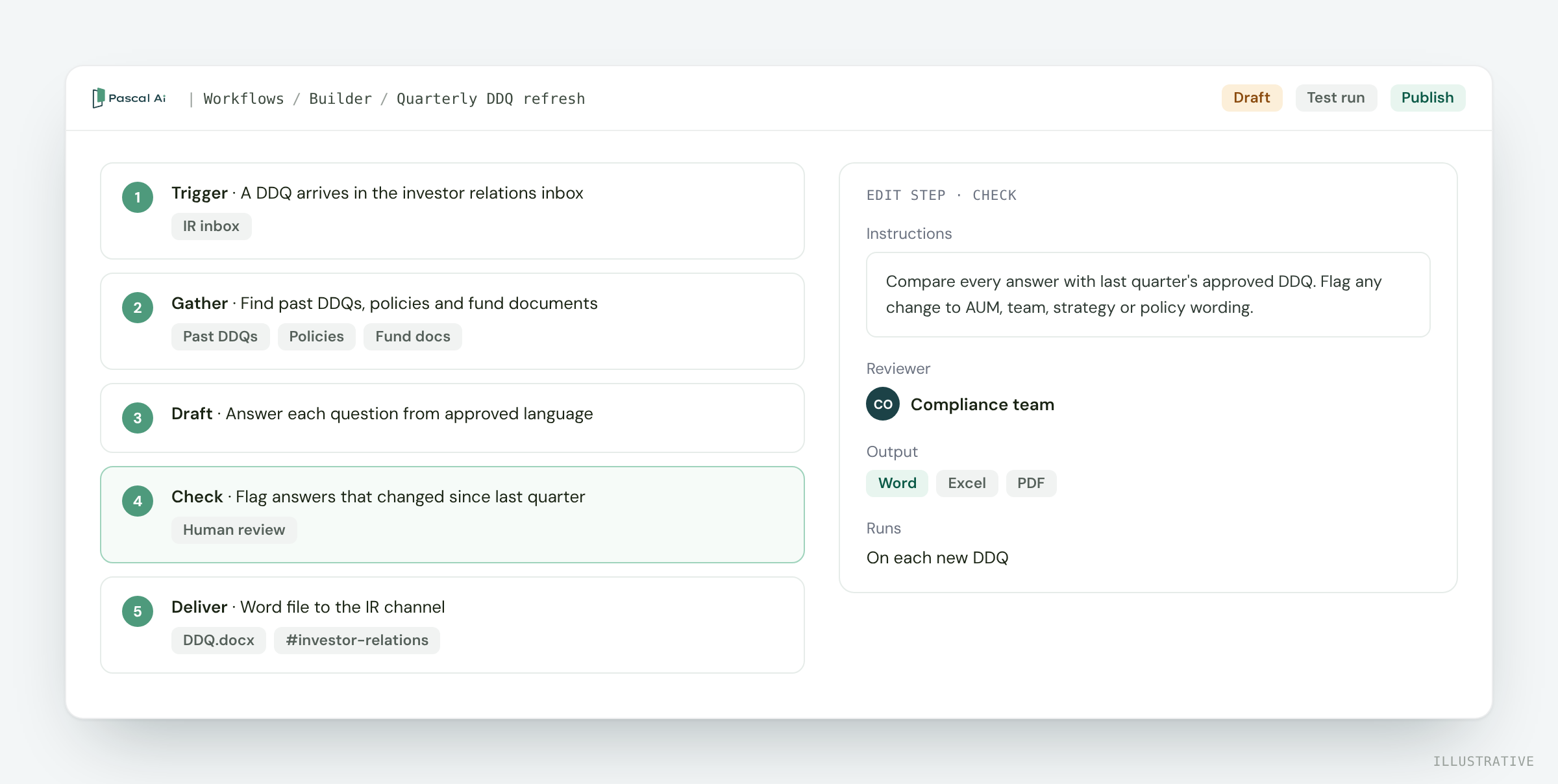
Pascal AI then compares every answer with the last approved DDQ and flags any change to AUM, team, strategy or policy wording. A compliance reviewer checks the flagged answers and approves the draft, and the finished DDQ is delivered to the investor relations team as a Word, Excel or PDF file. When compliance edits an answer, Pascal AI stores the edited version as the new approved answer, so the next questionnaire starts from it. Each step of the workflow can be edited in plain English: what starts it, where it looks, what it checks, who reviews it and where the output lands.
Access is checked per user and per source, so an answer that draws on a restricted document is visible only to people cleared to see that document. Pascal AI deploys inside the firm's own cloud or on-premises, with the Sovereign Data Fabric bringing the firm's data and Pascal AI's together inside that perimeter, and every query, answer and action is recorded in an audit log.
Read more about DDQ automation that reuses approved answers, or book a demo.
DDQ FAQs
What does DDQ stand for?
DDQ stands for due diligence questionnaire, the document investors and consultants send fund managers to assess a fund before investing and at regular intervals afterwards.
Who fills out a DDQ at a fund manager?
Investor relations or client service usually coordinates the response and owns the deadline. Section owners in portfolio management, compliance, legal and operations write and approve the answers for their areas.
How often should DDQ answers be updated?
Common practice is to review every answer at least once a year, and to update it whenever key facts change, such as team members, AUM, service providers or a material incident.
What's the difference between the ILPA and AIMA DDQs?
The ILPA DDQ is built for private equity and private markets funds. The AIMA DDQ is a modular questionnaire for hedge funds and other alternative managers, and its 2025 edition also covers private credit and private markets strategies. The templates section above explains both.
Are DDQ answers legally binding?
Investors rely on DDQ answers when they decide whether to invest, so the safest approach is to treat every answer as a representation by the firm. Whether a particular answer carries legal consequences depends on the jurisdiction and the fund's documents, which is why legal should approve the wording before submission.
Can AI complete a DDQ?
AI can draft a DDQ from a firm's approved answers and source documents, and people should review and approve every answer before it is submitted. The section on how Pascal AI answers a DDQ above walks through that process.
Closing
The managers who handle DDQs well have answers that are current, consistent with every other document the firm has sent, and approved by the people accountable for them. Fill in the form on our demo page and we'll email you the free DDQ response tracker to put that process in place for your next questionnaire.
Contact
USA
228 Park Ave S PMB 55152, New York
UK
86-90 Paul Street, EC2A 4NE, London
India
Indiqube Edge, ORR, Bangalore
Copyright © 2026 | All Rights Reserved
This site is protected by reCAPTCHA and the Google Privacy Policy and Terms of Service apply.