Unlocking AI Context: The Sovereign Data Fabric for Institutional Finance
For the last two years, the default assumption across institutional finance was that the smartest foundation model would automatically generate the highest alpha. The models have since kept getting smarter right on schedule, and the alpha has politely declined to follow.
A few weeks ago, Pascal AI labs hosted a private breakfast in London alongside the team at Atlas Technica to discuss exactly this problem. Around the table were partners, CIOs, CTOs, CDOs, and investment leaders from across the industry.
The conversation focused on a handful of themes that have become increasingly important as firms move from AI experimentation to AI deployment, how to generate investment insight in a way that remains verifiable, how to build systems that understand organizational context rather than simply retrieve information, and how to deploy AI inside environments governed by security, compliance, and fiduciary obligations.
The purpose of this blog is to walk through the main ideas that emerged from that discussion. What gives them weight is that they represent a rough consensus among the senior people in the room, the partners, MDs, COOs, and CIOs running alternative asset managers, and they line up closely with the patterns we keep seeing across investment firms as they move from experimentation to deployment.
How Deployment Has Aged: The AI Maturity Curve
Putting all those conversations on a single curve, you can see firms moving through five phases of maturity, and they cluster into three places along the way.
1. Where Most Firms Are Stuck
This covers the first two phases of the maturity curve and, in our experience, is where the majority of firms still sit today.
Phase one, the human intelligence stack, meaning no AI at all.
For the better part of the last 40 years, investment firms have operated on broadly the same stack. A typical asset manager runs on terminals, research management systems, internal databases, presentations, Excel sheets, and years of institutional memory held in people's heads. What all of these systems have in common is that they were built for human consumption. A Bloomberg terminal is the clearest example, where time series, charts, and dense visuals are arranged to land in a human eye and a human brain as quickly as possible, and the rest of the stack follows the same logic.
Phase two, AI on human rails.
With the arrival of modern AI systems, a lot of firms have taken that existing stack and connected it directly to frontier models, whether that is Claude, GPT, Perplexity, or agents they have built themselves. The problem is that the approach only works up to a point. While you see about 60% of tasks executed to perfection, you still have the remaining 40% where the system hallucinates, breaks, or fails an audit, because the data fed in was never agent-ready in the first place.
2. The Transition
What separates this phase from the earlier stages is that firms have begun changing the underlying system rather than simply layering AI on top of existing processes.
Phase three, re-architecting toward partial operability.
What this looks like in practice is a firm pulling specific datasets off human rails and restructuring them so a machine can query them, standing up connectors and structure for parts of the estate rather than all of it. A few workflows then run on properly structured, agent-ready data while the rest still runs on the old rails, and the results improve sharply in those pockets without yet covering the firm end to end. This is genuine progress, and it is also where the work gets hard, because turning fragmented internal data into something a model can query is mostly an upstream problem rather than a smarter-model problem.
3. Where the Industry Has to End Up
This covers the final two phases.
Phase four, agent-ready data, and phase five, agent-native investments.
To understand why that is the destination, it helps to be precise about what an agent actually is. The simplest way to put it is that an agent equals an LLM plus a harness, meaning a model doing the reasoning wrapped in the scaffolding that lets it plan the steps, call tools, retrieve what it needs, and run the loop until a task is finished rather than just answering a single question. The model supplies the intelligence, and the harness is what turns that intelligence into completed work.
Once you see it that way, what the agent consumes matters as much as how capable the model is. What an agent understands are entities, relationships, governance, and permissions, and it can read millions of pages or millions of rows in a single pass.
The very things that made information legible to the human eye (the charts, the colours, the dense visuals arranged to land on a Bloomberg screen) are close to useless to an agent, because none of that polish is what agentic consumption actually runs on.
What the agent needs is a structure built around entities and how they relate to one another. Once a firm's whole information estate is in that form, you reach agent-native investments, where the tasks an agent runs become end to end, auditable, reliable, and accurate.
One statistic worth sitting with is that agentic traffic on the web has now passed human traffic, so the direction of travel is not in doubt, and the firms that re-architect early are the ones who get there first.
The Stack We Think the Investment World Needs
Having framed the destination, it helps to walk the stack that gets a firm there, from the bottom up. There are three layers, and they sit on top of each other in a fairly natural order.
1. The Sovereign Data Fabric
At the bottom sits the data. The reality at a typical institution splits three ways, and it is worth being honest about where each part stands with respect to agentic consumption, because not all of a firm's data sits at the same level of readiness and some of it was never close to ready.
First there is data in the public domain, meaning filings, transcripts, news, and the signals floating around X, Reddit, and the rest, and a number of providers have already made this layer reasonably agent-ready.
Second there are the licensed feeds, meaning market data, broker research, and alternative data subscriptions, which are valuable but whose connectors were not built for agentic consumption yet.
Third, and most importantly, there is the internal proprietary data, meaning everything sitting in SharePoint, emails, SQL databases, and old models, which is the collective intelligence the firm has gathered over decades. One can fairly call that last bucket your IP, and it is both the most valuable of the three and the least agent-ready.
Pulling all three of these buckets together into a single agent-ready layer is the work of the re-architecting phase described above, and it is what we mean when we talk about the Sovereign Data Fabric. The Fabric connects to the structured and unstructured data a firm already runs through ready-made connectors, then ingests it, normalises it, and resolves the entities inside it.
A company that appears under five different names across five databases becomes one object, and a relationship that lived across five separate sources becomes one relationship. What you really get is information that was originally structured for human consumption turned into something an agent can query, without the client building custom pipelines to make it happen.
2. The Cognitive Engine
The Fabric gets the firm's information into one place. By itself that is a very well-organised pile, and the Cognitive Engine is the layer that turns the pile into something that can be reasoned over. It has three parts.
1) The first is the knowledge graph, which we call Lattice.
Over time, investors develop an internal map of the businesses they follow. This means that even a disclosure from a supplier changes how they think about a customer and a single line on an earnings call reframes a whole sector. Lattice builds that map explicitly in software, so every company, subsidiary, instrument, and fund holding becomes an object, and when a filing or transcript or research note enters the Fabric it gets attached to the entities it touches.
Information stops being trapped inside individual documents, and a question about one company can surface something material from a supplier filing or a competitor transcript because the system understands how the pieces connect.
2) The second is the document intelligence layer, which we call Prism.
As I've already established, most financial information was never designed to be consumed by a machine. Making it agent-ready starts with reconstructing the structure of the document itself, keeping tables as tables and footnotes attached to the numbers they explain.
The reason this is pretty important is because in institutional finance the footnote is frequently where the real story sits, and once a model loses the structure of a table it tends to lose the meaning of the number as well. Prism was built to hold up across the whole spectrum, from a clean SEC filing to a scanned PDF from a developing market with inconsistent formatting and handwritten annexures.
3) The third is permission-based access, which we call Shell.
Shell exists because of a problem that only appears once the rest of the system starts working.
A regulated financial institution runs on information boundaries that have been built up over decades and enforced with extraordinary care. Certain teams are allowed to access certain information while others are not. Deal rooms exist precisely because information cannot move freely across the organisation.
Restricted lists are restricted for a reason. Entire compliance functions exist to ensure that information flows exactly where it is supposed to flow and nowhere else.
3. Agents and Apps
Everything up to this point exists for a fairly simple reason. Once the Fabric has unified the firm's information estate and the Cognitive Engine has made that information understandable to machines, you need a way for people and agents to actually use it.
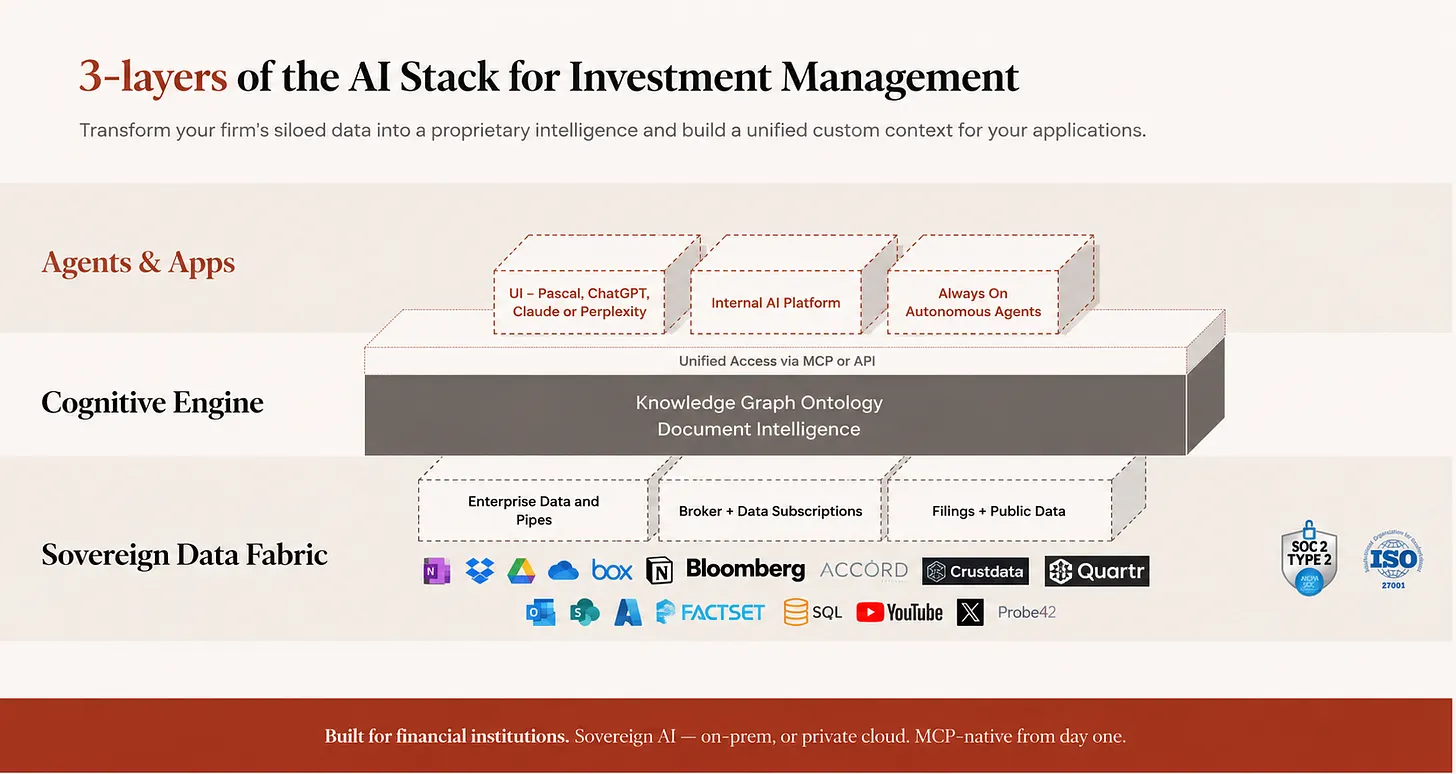
The important thing here is interoperability.
Different firms will want different front doors, meaning some will work through a dedicated Pascal interface, others through Claude or Perplexity, others inside an existing research system, and others inside applications they build themselves. The Fabric and the Cognitive Engine stay constant underneath, exposed through MCP and APIs to whatever interface sits on top.
Some workflows go fully headless, where an agent just consumes the information and completes the task, for instance noticing that quarterly earnings have landed, updating your NVIDIA model, flagging the deviations from your thesis, and sending you the summary without being asked.
We think that over the next two, three years a large share of enterprise agents will be built inside firms rather than bought, because every firm has its own process and its own way of looking at a company.
If you go back in history and think about Excel, each firm ended up with its own templates, and those templates quietly encode how the firm thinks. In many ways each template is already an agent, taking inputs, applying a proprietary framework, and producing an output, with a human analyst sitting in the middle doing the gluing. For that reason Pascal ships an agent builder, so a firm can encode its own frameworks and take the human out of the routing while keeping the judgment.
What This Looks Like in Practice
Now that the stack is laid out, it makes sense to move from architecture to workflow and see what the system actually does when faced with a real investment question.
One of my favourite examples came from a client who asked the system a deceptively simple question: "What was our thinking on a particular stock, how has that thinking evolved since we initiated the position, how have internal conversations across emails and chats influenced the thesis, and had the market gradually converged towards our view."
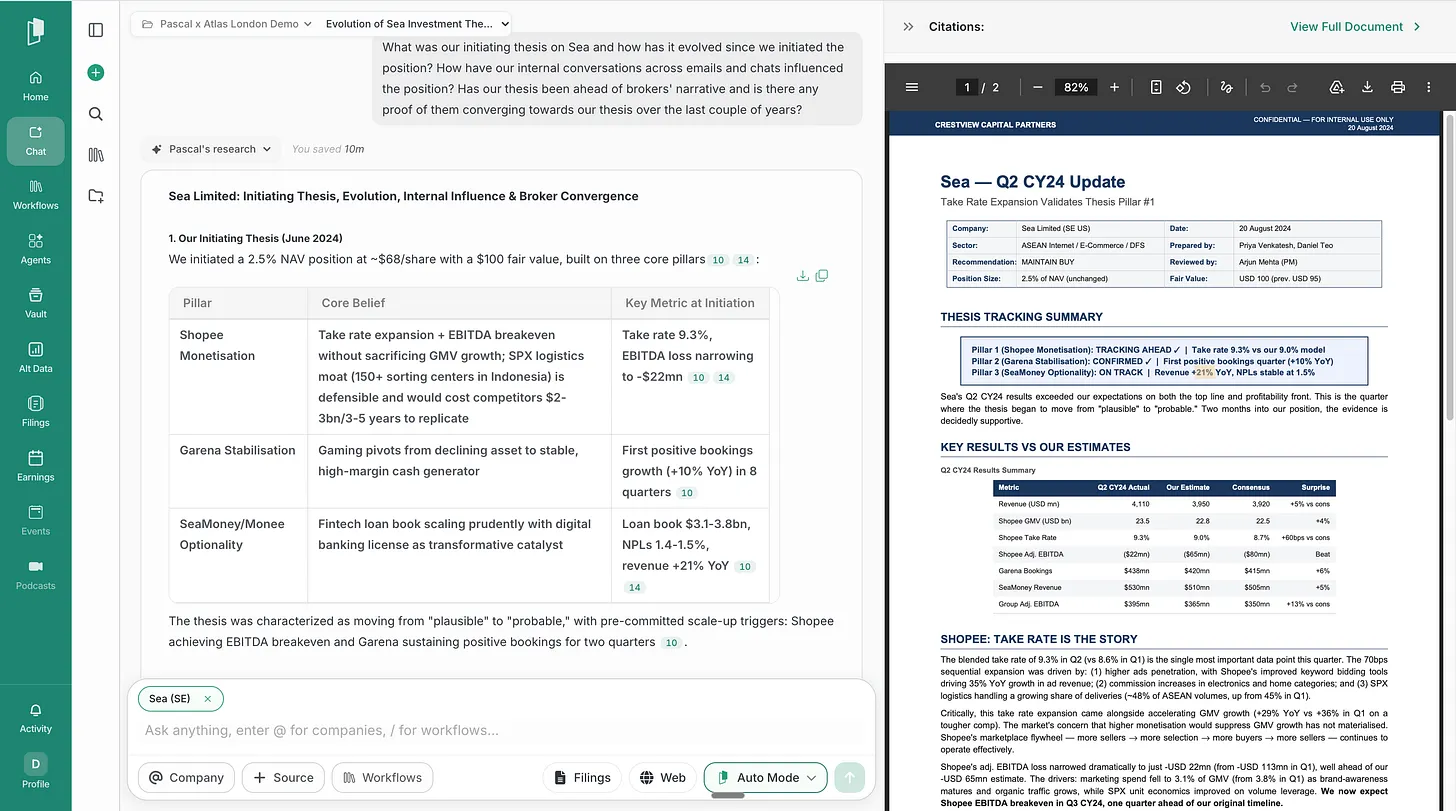
The user did not attach any files or doc.
What's particularly compelling here is that the system did not operate as a black box. As it worked through the problem, you could see the sequence of decisions it was making, which documents it chose to retrieve, which pages it considered relevant, which conversations it followed, and how it connected those pieces together. Every step was inspectable and every source was clickable.
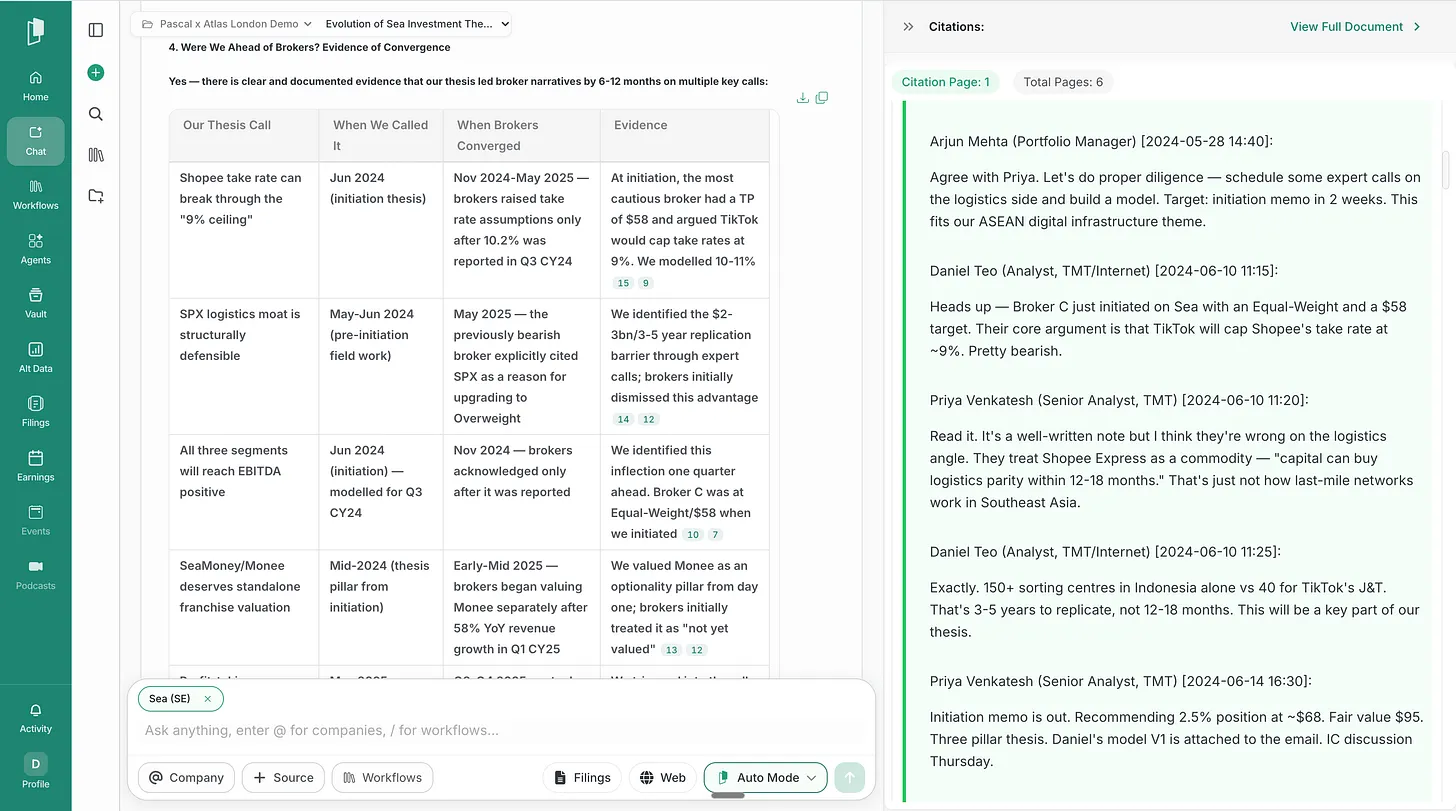
A surprising number of our users tell us they spend as much time reading the reasoning chain as they do reading the final answer because it often shows them where to dig deeper and what to investigate next.
Where the Alpha and the Moat Actually Live
The part that I really want to call out here is the economics underneath all of it. Every firm in that room has access to the same frontier models, so when intelligence is available to everyone at roughly the same price, the answer a raw model gives converges towards the same internet consensus. Ask one to summarise NVIDIA's latest quarter and you get the summary the whole street already has. The differentiator stops being the intelligence and becomes the context, because a firm's research, workflows, accumulated judgment, and institutional memory are proprietary by construction and cannot be copied overnight.
We compress this into a simple way of thinking about it, where performance is intelligence multiplied by context. The intelligence term keeps getting cheaper and more abundant, and the context term belongs to the firm and compounds for whoever owns it.
The architecture above is what turns that context from a liability sitting in inboxes into a queryable asset, since the Fabric unifies it, the Cognitive Engine makes it legible, and the agents put it to work while every output carries its citation trail. A firm that treats AI as infrastructure built on top of its own context ends up somewhere very different from one that treats it as a monthly subscription, and that gap widens every quarter the context accumulates.
There is a side effect of all this worth a quick word, which is what happens to token consumption as firms move from experiments to production. Every new workflow, agent, retrieval step, and reasoning chain pushes usage higher, and the better models often want larger and more expensive context windows, so AI budgets meant to last a year start running out in months.
Architecture is what keeps that in check, since narrowing each question to the handful of documents that matter, routing simpler tasks to cheaper models, and reusing structured context rather than rebuilding it from scratch means token spend on a well-architected system buys a compounding asset rather than a recurring bill.
Building for the Agentic Decade
Everything Pascal AI Labs does follows from this thesis, and the first place it shows up is in how we deploy. We deploy as software containers inside the firm's own environment, on-premise or in a private cloud, (in a model not far from how Palantir works), so the data never leaves the perimeter, we do not retain it, and we do not train on it.
Forward deployed engineers sit with the investment teams during onboarding, partly because the real investment process almost never matches the one written in the policy document, and you have to watch how decisions actually get made before you can put a system around them.
Today Pascal AI supports research workflows across institutions representing something like a trillion dollars in assets under management, spanning hedge funds, asset managers, and banks, with an average of ten interactions per user per day and a growing share of those started by agents rather than people.
None of this needs a breakthrough that has not already happened, because the models exist today. The work that remains is the plumbing and the governance that make them useful inside a real institution, and that is the work Pascal is built for.
FAQs
1. What is the difference between an LLM, a chatbot, and an AI agent?
An LLM is the raw model that predicts text, a chatbot is that model wrapped in a conversational interface, and an agent equals an LLM plus a harness, meaning the scaffolding that lets it plan steps, call tools, retrieve information, and run the loop until a task is finished.
The model supplies the intelligence, and the harness is what turns that intelligence into completed work. That difference is why agents need data structured for machines, while a chatbot can get by on whatever you paste into it.
2. What is a knowledge graph, and why does it matter for investment research?
A knowledge graph maps the entities a firm cares about, such as companies, subsidiaries, instruments, and fund holdings, along with the relationships between them. It matters for research because value often sits in the links rather than the single fact, so a question about one company can surface something material from a supplier filing or a competitor transcript.
3. How do you reduce AI hallucinations in financial analysis?
You reduce them by grounding every output in source documents, with citations down to the page and the line, so each claim can be traced rather than trusted. Feeding the model agent-ready data and exposing the reasoning chain helps as well, since a reviewer can see which documents the agent pulled and which it judged relevant.
4. Why do enterprise AI and token costs grow so fast?
Token usage climbs because every new workflow, agent, retrieval step, and reasoning chain adds consumption, and the stronger models often want larger and more expensive context windows. The result is that AI budgets meant to last a year can run out in months once a firm moves from experiments to production. Architecture is the main lever, since retrieving only the passages that matter, routing simpler tasks to cheaper models, and reusing structured context keeps spend from scaling linearly with usage.
5. What does Pascal AI Labs do?
Pascal AI Labs builds a context-driven enterprise AI operating system for institutional finance, used today across firms representing almost a trillion dollars in assets under management. It unifies a firm's public, licensed, and internal data into an agent-ready layer, runs a knowledge graph and document intelligence on top, and exposes that intelligence through APIs and MCP to whichever interface or agent a firm prefers. The software deploys inside the firm's own environment, so the data never leaves the perimeter and is never used to train shared models.
Contact
USA
228 Park Ave S PMB 55152, New York
UK
86-90 Paul Street, EC2A 4NE, London
India
Indiqube Edge, ORR, Bangalore
Copyright © 2026 | All Rights Reserved
This site is protected by reCAPTCHA and the Google Privacy Policy and Terms of Service apply.